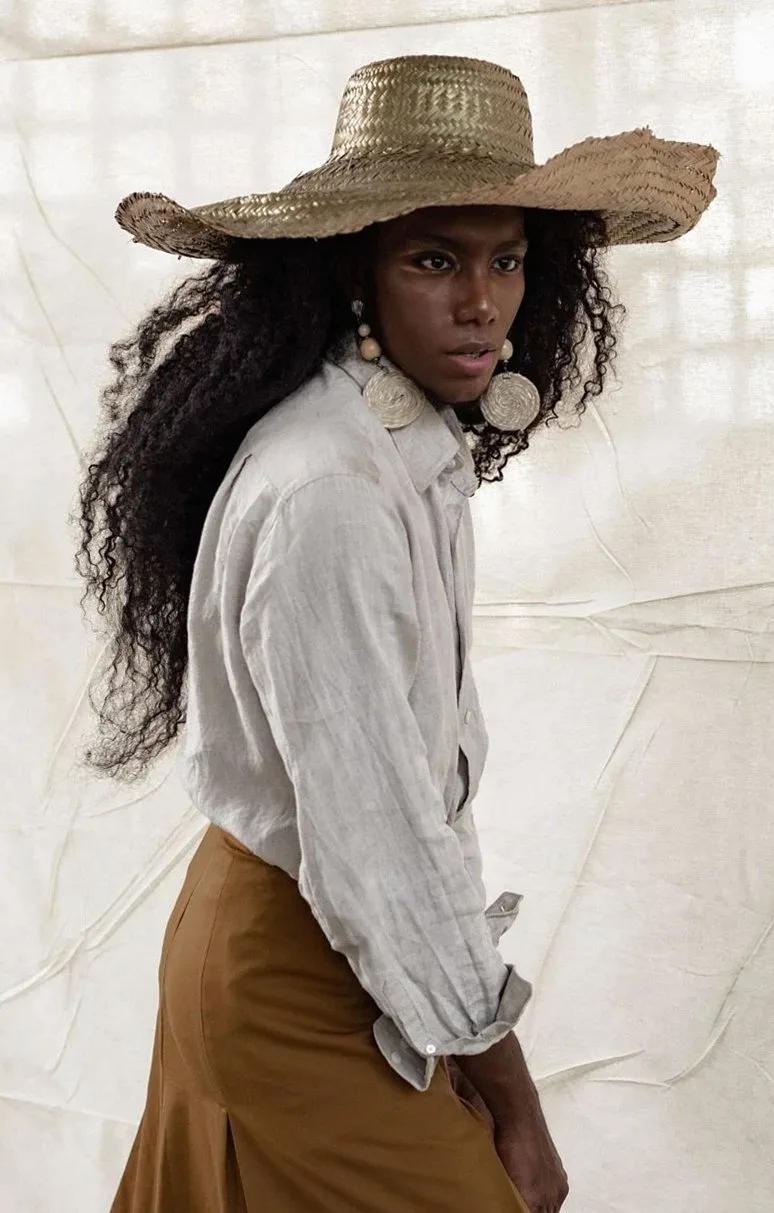
Linen is usually sold as a summer fabric in Japan, and for most of the country that framing is accurate. But where autumn arrives earlier and the temperature drops more sharply, a heavier linen shirt occupies a useful middle ground between summer cotton and winter wool. This is a short account of why, and what to look for.
01 How linen behaves in cool temperatures
Linen is a strong fibre with a relatively open weave structure. It breathes well, which is why it is associated with summer, but it also has a natural stiffness that gives it some body in cooler air. A heavier linen shirt, woven at 160gsm or above, will feel substantial in October in a way that a lightweight summer linen will not.
The fibre also softens with each wash rather than degrading. A linen shirt bought in September will feel noticeably different by the following spring, and better. This is one of the qualities that makes it a useful long-term piece rather than a seasonal one.
02 Layering a linen shirt in a cool autumn
The practical case for linen in a cool autumn is that it layers well under wool. The weave structure does not compress and trap heat the way a thicker cotton flannel does, which means you can wear it under a wool coat without overheating indoors. It also does not cling to a wool mid-layer the way synthetic fabrics tend to.
The indigo-dyed linen shirt in the current collection has a slightly dropped shoulder that gives it enough room to layer a light merino underneath on colder days. The colour deepens with washing, which means it looks better the longer you have it.
03 The vat-indigo dyeing process
Vat indigo is a reduction dyeing process. The indigo pigment is insoluble in water in its natural state and must be chemically reduced to a soluble form before it can bond with the fibre. The fabric is dipped, exposed to air, and dipped again, with each cycle adding depth to the colour. The number of dips determines the final shade.
The characteristic of vat-indigo dye is that it bonds to the surface of the fibre rather than penetrating it fully. This is why indigo-dyed fabric fades in a particular way: the raised points of the weave lose colour first, creating a subtle variation across the surface. On a linen shirt, this process takes longer than on denim, but the result is similar.
The indigo-dyed linen shirt is part of the current collection. Indigo reads differently in daylight than on a screen, so ask us to describe the colour in words before you decide.